

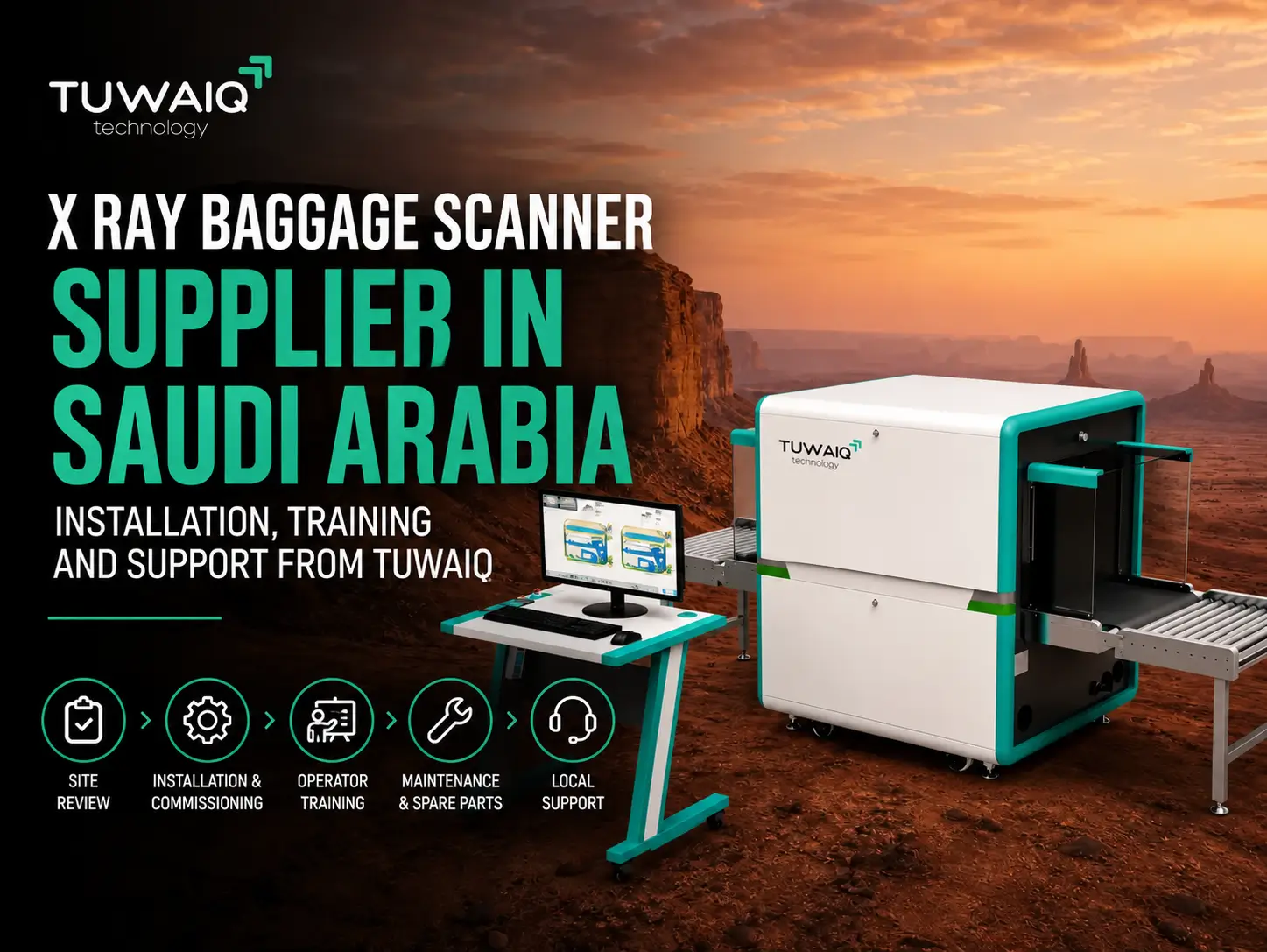
X Ray Baggage Scanner Supplier in Saudi Arabia: Installation, Training and Support from Tuwaiq
Choosing an X ray baggage scanner supplier in Saudi Arabia is not only about selecting a machine and receiving a quotation.
For airports, government buildings, hotels, commercial facilities, logistics hubs and other security-sensitive sites, the real work begins after the equipment is ordered.
The scanner must suit the application, installation conditions need to be reviewed, the system must be properly commissioned, operators need practical training, and ongoing technical support must be available throughout the equipment lifecycle.
Tuwaiq Technology supports customers through this complete process, helping move a project from product selection to an operational security screening checkpoint.
If you are planning a new project, upgrading an existing checkpoint or adding screening capacity at multiple locations, here is what you can expect after ordering an X-ray baggage scanner.
Step 1: Confirming the Screening Requirement
Before installation planning begins, the first step is confirming exactly what the scanner needs to do.
A hotel entrance does not necessarily have the same screening requirements as an airport, logistics facility or government building. The type and size of items being inspected, expected daily traffic, available entrance space and operating environment all influence the equipment selection.
The technical review may consider factors such as:
- Type of facility and security checkpoint
- Bags, parcels or cargo being screened
- Expected screening volume
- أبعاد نفق الفحص المطلوبة
- Available installation space
- Operating hours and usage pattern
- Single-view or dual-view screening requirements
- Integration or accessory requirements
- Power and site conditions
This helps ensure that the selected X-ray scanner is appropriate for the real operating environment rather than simply being chosen from a catalogue.
Tuwaiq offers a range of تُعد أجهزة فحص الأمتعة بالأشعة السينية covering compact parcel inspection, standard checkpoints, larger baggage and cargo-screening applications.
For a broader explanation of selecting a scanner for different Saudi facilities, read our complete guide to X-ray baggage scanners for Saudi airports, hotels and government buildings.
Step 2: Site Review and Installation Planning
Once the equipment requirement has been confirmed, attention moves to the location where the scanner will operate.
Depending on the project, this may involve a technical site review or site survey to confirm that the proposed checkpoint can accommodate the equipment and support an efficient screening workflow.
The review can include the scanner footprint, entrance dimensions, conveyor position, operator location, electrical supply, movement of people and baggage, and any additional equipment planned around the checkpoint.
This stage is especially important when an X-ray baggage scanner will operate together with a walk-through metal detector, handheld metal detector, access-control point or security desk.
Good checkpoint planning is not simply about fitting equipment into an available space. People, baggage and security personnel should be able to move through the area in a controlled and practical way.
For larger or multi-site projects, installation planning also helps coordinate delivery, access requirements and implementation across different locations.
Step 3: Delivery and Equipment Positioning
The next stage is coordinating equipment delivery and moving the scanner into its planned operating position.
X-ray baggage scanners are specialized security systems, so delivery should be planned around site access, equipment dimensions and the final installation location.
Before delivery, the project team should confirm practical details such as access routes, door and corridor dimensions, loading or unloading arrangements and the route from the delivery point to the checkpoint.
This is particularly important for larger tunnel systems and cargo scanners.
Correct planning at this stage reduces unnecessary movement after delivery and helps the installation team position the system efficiently.
Step 4: Professional Installation and Commissioning
Once the scanner has been positioned, installation and commissioning can begin.
Commissioning is an important part of the process because the goal is not simply to power on the equipment. The system needs to be checked and prepared for its intended operating environment.
Depending on the configuration and project scope, this can include:
- Equipment assembly and positioning
- Power and system connections
- Conveyor and operational checks
- Image-system verification
- Safety and functional checks
- Configuration of relevant operating settings
- Testing of accessories or connected components
- Final operational testing before handover
The installation team can also review the surrounding checkpoint to make sure the scanner is positioned appropriately for daily use.
Tuwaiq Technology provides lifecycle project support covering consultation, installation, commissioning, training, maintenance and technical assistance.
You can learn more about Tuwaiq Technology and its security screening capabilities.
Step 5: Operator Training
Even an advanced X-ray baggage scanner depends on trained operators.
After installation and commissioning, the personnel who will use the scanner should understand both the equipment and the correct operating workflow.
Operator training can cover areas such as starting and shutting down the system, conveyor operation, image controls, basic image interpretation, alarm handling, routine checks and appropriate responses when an item requires further inspection.
Training is also important for supervisors who may be responsible for monitoring operators, reviewing procedures or coordinating the checkpoint.
The objective is to help security personnel use the equipment consistently and confidently in day-to-day operations.
For facilities operating multiple shifts, organizations should also consider how trained knowledge will be maintained when new operators join the security team.
Step 6: Testing and Handover
Before a newly installed scanner becomes part of normal security operations, the system should complete final functional checks.
The handover stage confirms that the agreed equipment has been installed, tested and prepared for operation.
Depending on the project, handover may include relevant technical documentation, equipment information, operating guidance and service contact details.
This also gives the customer an opportunity to confirm who should be contacted for technical questions, maintenance requirements or spare parts after the system enters service.
A structured handover creates a clear transition from project installation to normal operations.
Step 7: Preventive Maintenance
An X-ray baggage scanner may operate for many hours each day, particularly at airports, government facilities, hotels, logistics hubs and other busy security checkpoints.
Routine maintenance therefore becomes an important part of long-term system reliability.
Preventive maintenance can help identify wear, operational issues or service requirements before they develop into more disruptive problems.
A maintenance program may include inspection of key system components, conveyor operation, sensors, safety functions, system condition and other items relevant to the equipment.
The exact maintenance schedule should be based on the scanner configuration, level of use, operating environment and agreed service requirements.
When evaluating an X ray baggage scanner supplier in Saudi Arabia, buyers should therefore consider support after installation as part of the procurement decision, not only the initial equipment price.
Step 8: Spare Parts and Technical Support
Security screening equipment is operational infrastructure. If a scanner develops a problem, the impact can extend beyond the machine itself and affect the entire checkpoint.
Access to technical assistance and spare-parts support is therefore an important part of equipment lifecycle planning.
Organizations should understand how service requests will be handled, what preventive support is available, how spare parts are managed and who their technical point of contact will be.
Tuwaiq Technology provides service and technical support for commissioning, maintenance, spare parts and operational requirements.
For service-related enquiries, customers can contact Tuwaiq Technology to discuss technical support or project requirements.
Why After-Sales Support Matters When Choosing a Supplier
Two X-ray scanners may appear similar during the purchasing stage, but the overall experience can be very different once the systems are deployed.
Procurement teams should therefore assess the complete lifecycle rather than focusing only on the equipment specification.
A suitable supplier should be able to support the project through product selection, technical planning, installation, commissioning, operator training and ongoing maintenance.
This becomes even more important for facilities where security screening is carried out every day and equipment availability directly affects entrance operations.
Tuwaiq Technology’s approach is built around supporting screening projects beyond equipment delivery, with lifecycle services covering implementation and long-term technical support.
An X-ray baggage scanner often forms only one part of an entrance security system.
Depending on the facility and risk profile, a complete checkpoint can combine:
- An X-ray baggage scanner for bags and parcels
- جهاز walk-through metal detector for personnel screening
- جهاز handheld metal detector for targeted secondary screening
- Security personnel and defined inspection procedures
- Supporting checkpoint and access-control infrastructure
Planning these elements together can create a more organized screening process than treating each device as an independent purchase.
Tuwaiq Technology supplies X-ray baggage scanners, walk-through metal detectors and handheld metal detectors for security screening applications across Saudi Arabia and the wider GCC.
Choosing an X Ray Baggage Scanner Supplier in Saudi Arabia
If your organization is evaluating an X ray baggage scanner supplier in Saudi Arabia, look beyond the equipment datasheet.
Ask what happens after the purchase.
Who reviews the application? Who supports installation? Who commissions the machine? How will operators be trained? What happens when maintenance is required? Where will technical support and spare-parts assistance come from?
The answers to these questions can be just as important as tunnel size, imaging technology or scanner configuration.
Buyers on airport or critical infrastructure projects should also review our guide to GACA and HCIS compliance requirements and our overview of security screening for Vision 2030 projects.
Tuwaiq Technology supports customers from initial technical consultation through installation, commissioning, training and ongoing service requirements, helping organizations build dependable security-screening operations.
For buyers comparing different scanner technologies and facility requirements, our complete guide to X-ray baggage scanners in Saudi Arabia provides additional guidance.
Planning an X-Ray Baggage Screening Project in Saudi Arabia?
Explore the complete range of Tuwaiq X-ray baggage scanners أو contact Tuwaiq Technology your X ray baggage scanner supplier in Saudi Arabia, to discuss your facility, application, quantity and project requirements.
Our team can review your requirements and help identify a suitable screening configuration for your project.
الأسئلة الشائعة
اسألنا
عن كل ما يهمك
Does Tuwaiq Technology install X-ray baggage scanners in Saudi Arabia?
Tuwaiq Technology provides project support covering X-ray baggage scanner installation, commissioning, training, maintenance and technical assistance. The exact project scope can be confirmed based on the facility, equipment and installation requirements.
What happens after ordering an X-ray baggage scanner?
The typical process includes confirming the technical requirement, reviewing installation conditions, coordinating delivery, installing and commissioning the equipment, training operators, completing handover and arranging ongoing maintenance and technical support as required.
Does an X-ray baggage scanner require operator training?
Yes. Operators should understand how to use the scanner controls, manage baggage flow, interpret screening images, perform routine operational checks and follow the site’s security procedures when further inspection is required.
Does Tuwaiq provide maintenance and spare-parts support?
Tuwaiq Technology provides technical support covering maintenance, commissioning, spare parts and operational support. Service requirements can be discussed with the technical support team based on the installed equipment and project.
Which X-ray baggage scanner is suitable for my facility?
The appropriate scanner depends on factors such as the facility type, items being inspected, expected screening volume, required tunnel size, available space and security requirements.
Explore the Tuwaiq X-ray baggage scanner range to review available systems.Can an X-ray baggage scanner be combined with metal detection?
Yes. Many security checkpoints use an X-ray baggage scanner for bags and parcels together with a walk-through metal detector for personnel and a handheld metal detector for secondary screening.
The appropriate configuration depends on the site’s security and operational requirements.