

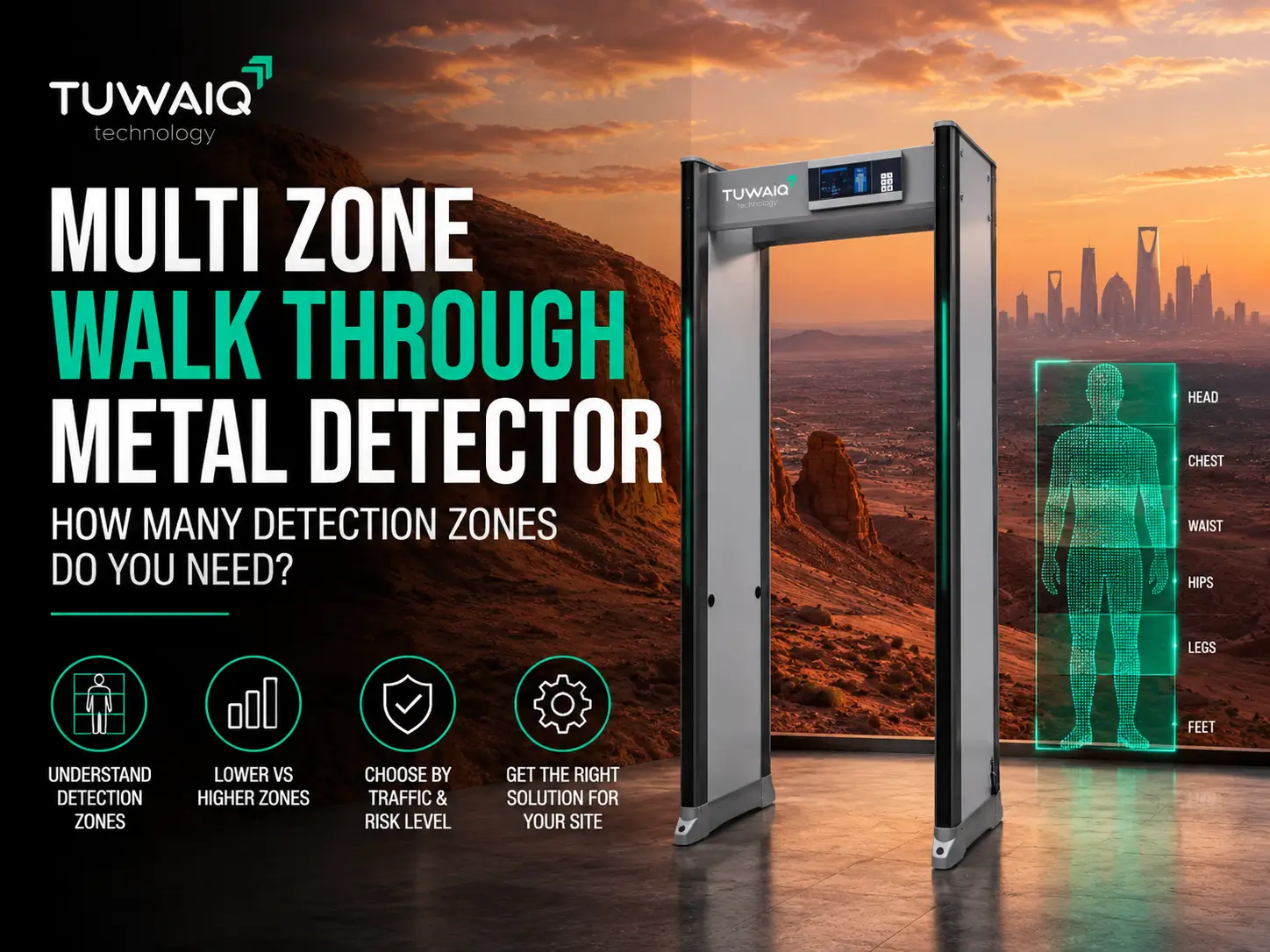
Multi Zone Walk Through Metal Detector: How Many Detection Zones Do You Need?
When comparing a multi zone walk through metal detector, one specification appears again and again: the number of detection zones.
8 zones. 18 zones. 33 zones. 45 zones.
It can be tempting to assume that the detector with the highest number is automatically the best choice.
But that is not how zone count should be evaluated.
Detection zones primarily determine how precisely the system can indicate where metal has been detected on the body. They help security personnel move from a general alarm to a more focused secondary inspection.
The appropriate number of zones therefore depends on the facility, visitor volume, security level, checkpoint workflow and how quickly operators need to resolve alarms.
This guide explains what detection zones actually mean and how Saudi facilities can choose between lower-zone and higher-zone walk-through metal detectors.
What Is a Detection Zone in a Walk Through Metal Detector?
A detection zone is an area within the walk-through detector’s screening field.
When a person passes through the gate carrying a metallic object above the configured detection threshold, the detector generates an alarm.
In a basic system, the operator may simply know that metal has been detected somewhere on the person.
جهاز multi zone walk through metal detector provides more information.
The detector divides the screening area into multiple detection zones and uses visual indicators to show the approximate location where the alarm occurred.
For example, the system may indicate that metal has been detected around the:
- Upper body
- Chest
- Waist
- Left or right side
- Lower body
- Leg area
- Foot or ankle area
The more detailed the zone structure, the more precisely the system can help the operator identify the relevant part of the body.
This can make secondary inspection faster and more focused.
Explore the complete range of Tuwaiq walk-through metal detectors.
Does More Detection Zones Mean Better Metal Detection?
Not automatically.
This is one of the most important points when comparing walk-through metal detectors.
A higher number of zones mainly improves alarm localization.
It does not mean that zone count alone determines whether a detector can detect a particular metallic object.
Overall screening performance is influenced by several factors, including:
- Sensitivity settings
- Detector design
- Signal processing
- المعايرة
- Type and size of the metallic object
- Operating frequency
- Environmental interference
- Installation conditions
- Security program selected
- Operator procedures
For this reason, buyers should not choose a WTMD simply because one specification sheet shows more zones than another.
The correct question is:
How much alarm-location detail does our checkpoint actually need?
Detection Zones vs Sensitivity: What Is the Difference?
Zone count and sensitivity are related to screening performance, but they are not the same thing.
مناطق الكشف
Detection zones help identify where an alarm occurs.
A greater number of zones can provide more precise localization.
الحساسية
Sensitivity determines how the detector responds to metallic objects based on the configured screening requirement.
If sensitivity is configured too high for the operating environment, everyday metallic items may generate unnecessary alarms.
If it is configured incorrectly in the opposite direction, the screening program may not perform as intended.
This is why proper commissioning and site-specific configuration are important.
A high-zone detector with poor configuration will not automatically create an efficient checkpoint.
Likewise, a lower-zone detector that is correctly selected and configured can be entirely appropriate for many applications.
Do More Zones Reduce False Alarms?
Not directly.
A common misconception is that adding more detection zones automatically eliminates false alarms.
In practice, nuisance or unnecessary alarms can be affected by:
- Sensitivity configuration
- Nearby metallic structures
- Electrical or electromagnetic interference
- Moving metal objects
- Incorrect installation
- Adjacent screening equipment
- Personal items carried by visitors
- Site-specific environmental conditions
More zones can, however, make an alarm easier to resolve.
If a detector clearly identifies the approximate alarm location, the security officer can focus secondary inspection on that particular area rather than checking the whole person again.
That can improve checkpoint efficiency, particularly at busy entrances.
Lower-Zone vs Higher-Zone Walk Through Metal Detectors
The best way to choose a detector is to consider how the checkpoint will operate.
Lower-Zone Walk Through Metal Detector
A lower-zone WTMD provides broader alarm-location information.
It can be suitable where:
- Visitor volume is low to moderate
- Checkpoint security requirements are straightforward
- Temporary deployment is important
- Equipment needs to be easy to reposition
- Detailed alarm localization is not the main requirement
- Secondary screening can be performed without creating significant queues
A compact lower-zone detector can therefore be a practical solution for schools, events, temporary entrances and some commercial applications.
The Tuwaiq INSPECTA™ 8WPZ provides 8-zone detection in a compact format for permanent and temporary personnel-screening checkpoints.
Higher-Zone Walk Through Metal Detector
Higher-zone systems provide more detailed localization of detected metal.
They are particularly valuable when:
- Visitor throughput is high
- Faster alarm resolution is required
- The facility has a higher security profile
- Multiple body areas need clearer differentiation
- Secondary screening delays can create queues
- The checkpoint operates continuously
- Security personnel need more precise alarm-location guidance
These characteristics make higher-zone systems suitable for demanding environments such as airports, government facilities, customs areas, critical infrastructure and major public venues.
The Tuwaiq INSPECTA™ 45Z provides 45-zone height-on-person alarm localization for advanced personnel screening.
8 Zones vs 45 Zones: What Changes for the Operator?
Consider two checkpoints.
At the first checkpoint, an 8-zone detector generates an alarm and indicates the general area where metal has been detected.
This may already provide enough information for the officer to conduct a quick secondary check.
At another high-volume checkpoint, a 45-zone detector can provide more detailed height-on-person localization.
The operator receives more precise information about the approximate alarm position and can direct the secondary inspection accordingly.
The difference is therefore not simply:
<
8 zones = basic
45 zones = better
The more useful comparison is:
How much localization does the site require to maintain its desired security process and visitor flow?
How Many Zones Does Your Site Need?
There is no universal zone count that is correct for every facility.
The selection should be based on the checkpoint.
Schools and Educational Facilities
Schools may need personnel screening during normal entry periods, special events or specific security situations.
For a site where portability, easy deployment and straightforward screening are priorities, a compact lower-zone detector may be suitable.
If the school has a high-volume permanent entrance or requires more detailed alarm localization, a higher-zone system may be considered.
Consider:
- Number of people entering at peak time
- Permanent vs temporary screening
- Number of security officers
- Available entrance space
- Required level of secondary screening
For flexible applications, an 8-zone walk-through metal detector can provide a practical starting point.
الفنادق
Hotels need to balance security screening with smooth guest movement.
A detector must allow the security team to identify alarms without creating an unnecessarily disruptive entrance process.
Lower to mid-level localization may be adequate for some hotel applications, while higher-zone systems can be useful at large properties, major events or more security-sensitive sites.
The decision should be based on:
- Guest volume
- Event activity
- Entrance configuration
- Security procedures
- Secondary screening process
Hotels screening guest bags should also consider combining personnel screening with an X-ray baggage scanner.
Shopping Malls and Public Venues
Shopping malls and major venues can experience significant peaks in visitor traffic.
At these sites, the speed at which security personnel resolve alarms becomes important.
A higher-zone detector can provide more detailed alarm localization, helping officers focus secondary screening on the relevant body area.
The complete checkpoint should also consider:
- Number of screening lanes
- Peak visitor volume
- Queue management
- Secondary-screening space
- Placement of nearby security equipment
- Operator staffing
Zone count should therefore be considered as part of the overall checkpoint design rather than in isolation.
Government Buildings
Government buildings typically operate controlled entrances and may require more structured personnel screening.
A higher-zone WTMD can be useful where security teams need detailed alarm localization and consistent screening throughout the working day.
Possible applications include:
- Ministries
- Administrative buildings
- Courts
- Government offices
- Controlled visitor entrances
- Secure facilities
For more demanding personnel-screening environments, the INSPECTA™ 45Z provides 45 detection zones with height-on-person indication.
Airports, Customs and Critical Infrastructure
At higher-security facilities, equipment selection normally involves more than simply comparing zone numbers.
Airport, customs and critical-infrastructure screening may require consideration of:
- Threat-detection requirements
- Screening volume
- Required security programs
- Alarm-resolution speed
- Interference conditions
- Multiple screening lanes
- Operational uptime
- Integration with checkpoint procedures
More detailed alarm localization can be valuable in these environments because every secondary inspection can affect passenger or visitor flow.
Higher-zone WTMDs are therefore commonly considered for demanding high-throughput security checkpoints.
Choose Zone Count Based on Traffic and Risk
A simple way to approach the decision is to evaluate two factors:
حجم الحركة و security requirement.
| Site Requirement | Zone Approach |
|---|---|
| Low traffic + straightforward screening | Lower-zone system may be sufficient |
| Temporary or flexible checkpoint | Compact lower-zone system |
| Moderate traffic + controlled entrance | Multi-zone system selected around workflow |
| High traffic + faster alarm resolution | Higher-zone system |
| Government / secure facility | Higher-detail localization may be valuable |
| Airport / critical infrastructure | Advanced higher-zone screening should be evaluated |
This is a selection framework, not a fixed rule.
The final detector should always be matched to the site’s actual security assessment and operating conditions.
Zone Count Is Only Part of the Checkpoint
Even the most advanced multi-zone detector cannot compensate for poor checkpoint planning.
When specifying a WTMD, facility and security teams should also evaluate:
Screening Throughput
How many people must pass through the checkpoint during the busiest period?
The important figure is often the peak entrance period rather than the daily average.
Secondary Screening
Where will a person go if an alarm occurs?
If secondary screening blocks the main lane, overall throughput will fall regardless of how advanced the detector is.
أجهزة كشف المعادن المحمولة باليد
جهاز handheld metal detector gives the operator a practical way to investigate an alarm identified by the WTMD.
Walk-through and handheld detectors therefore work particularly well together.
Bag Screening
Personnel screening does not inspect bags and personal belongings.
Where required, an X-ray baggage scanner can operate alongside the WTMD to create a layered security screening point.
Installation Environment
Nearby metal, electrical equipment and other screening systems can affect detector operation if the checkpoint is not planned correctly.
Site review, installation and commissioning are therefore important regardless of zone count.
Why Higher Zone Count Can Improve Checkpoint Efficiency
The operational benefit of higher-zone detection is primarily localization.
Imagine that a visitor triggers an alarm.
With limited location information, an officer may need to conduct a broader secondary inspection.
With detailed zone indication, the detector can help identify whether the alarm is around the upper body, waist, leg or another area.
The handheld detector can then be directed toward that area.
At a single checkpoint, the time difference may appear small.
Across hundreds or thousands of people, however, faster alarm resolution can make the screening process more efficient.
That is why zone count becomes increasingly relevant as traffic volume and security requirements increase.
Avoid Choosing a Detector by Zone Count Alone
A procurement specification that simply says “minimum 45 zones” does not automatically guarantee the right screening system.
Buyers should evaluate the complete detector.
Important questions include:
- Can sensitivity be configured for the site?
- How is the alarm location displayed?
- Can the operator easily understand the indication?
- How does the detector manage environmental interference?
- Can multiple detectors operate near one another?
- What security settings are available?
- Is traffic counting required?
- Does the site need network connectivity?
- Is backup power required?
- What installation and technical support are available?
Zone count is important, but it should be evaluated as one part of the overall screening requirement.
Tuwaiq Multi Zone Walk Through Metal Detectors
Tuwaiq Technology provides multi-zone personnel-screening solutions for different checkpoint requirements across Saudi Arabia and the GCC.
إنسبكتا™ 8WPZ
The إنسبكتا™ 8WPZ provides compact 8-zone detection for flexible personnel screening at permanent and temporary checkpoints.
It is suited to applications where mobility, compact deployment and straightforward alarm localization are important.
إنسبكتا™ 45Z
The إنسبكتا™ 45Z provides 45-zone height-on-person localization for demanding personnel-screening environments.
It is designed for sites requiring more detailed alarm-location information and advanced checkpoint operation.
For a closer look at the technology and features behind Tuwaiq’s higher-security walk-through screening, read الدرع الخفي: إعادة تعريف أنظمة التفتيش الأمني عبر البوابات مع سلسلة حارس من طويق تكنولوجي.
Which Multi Zone Walk Through Metal Detector Should You Choose?
Choose based on the checkpoint, not simply the highest available number of zones.
A lower-zone system may be appropriate when:
- Traffic is manageable
- Deployment flexibility is important
- The screening process is straightforward
- Broad alarm localization is sufficient
A higher-zone system may be appropriate when:
- Visitor volume is high
- Security requirements are more demanding
- Faster alarm resolution is important
- More precise body-location indication is required
- The checkpoint operates continuously
For many projects, the correct detector can only be selected after considering visitor traffic, site layout, security procedures and the complete screening workflow.
Need Help Selecting the Right Zone Count?
If you are planning a personnel-screening checkpoint in Saudi Arabia, Tuwaiq Technology can review your site requirements and help identify the appropriate walk-through metal detector configuration.
استكشف المجموعة الكاملة من Tuwaiq walk-through metal detector range أو contact Tuwaiq Technology to discuss your project.
الأسئلة الشائعة
اسألنا
عن كل ما يهمك
What does multi zone mean in a walk through metal detector?
A multi-zone walk-through metal detector divides the screening field into several detection areas. When metal is detected, visual indicators help the operator identify the approximate location of the object on the person’s body.
Is a 45-zone metal detector better than an 8-zone detector?
Not for every application. A 45-zone detector provides more detailed alarm localization, while an 8-zone detector may be sufficient for checkpoints where broader localization and flexible deployment meet the operating requirement.
Does a higher number of zones increase detection accuracy?
Higher zone count primarily improves the precision of alarm-location information. Overall detection performance also depends on sensitivity, configuration, installation conditions, detector technology and the site’s screening requirements.
Do more zones reduce false alarms?
More zones do not automatically prevent nuisance alarms. Sensitivity settings, environmental interference, installation and operating procedures are important factors. More detailed zones can, however, help operators resolve an alarm faster by identifying the approximate location.
How many detection zones do I need for a government building?
The correct zone count depends on visitor volume, security requirements and checkpoint procedures. Higher-zone detectors can be useful for government facilities where detailed alarm localization and fast secondary screening are important.
What is the difference between 8-zone and 45-zone walk-through metal detectors?
An 8-zone detector provides broader alarm-location information, while a 45-zone detector provides more detailed body-location indication. The appropriate choice depends on the site’s traffic, risk level and screening workflow.
Does Tuwaiq Technology offer different zone configurations?
Yes. Tuwaiq Technology offers the إنسبكتا™ 8WPZ with 8-zone detection and the إنسبكتا™ 45Z with 45-zone height-on-person localization.