

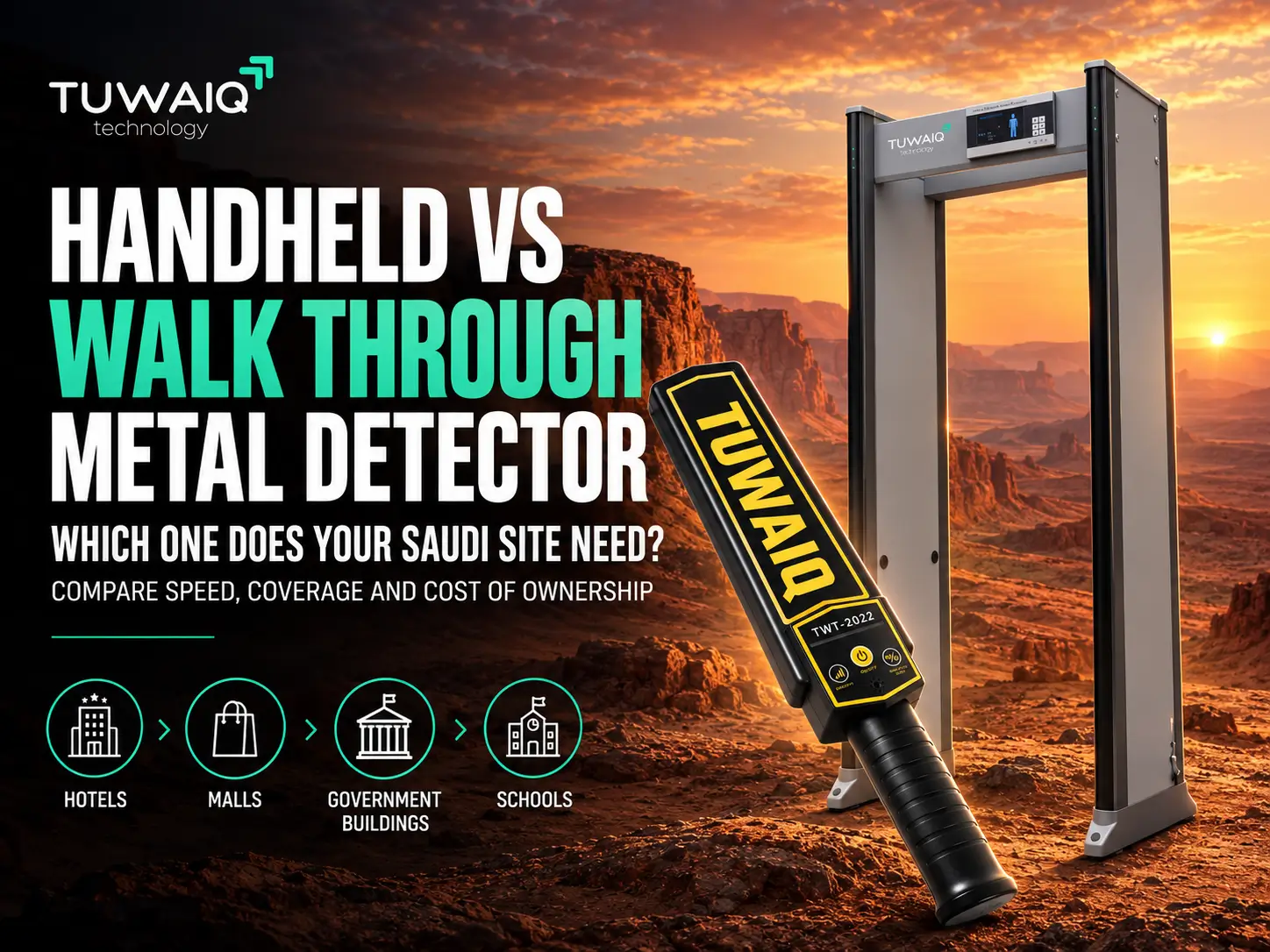
Handheld vs Walk Through Metal Detector: Which One Does Your Saudi Site Need?
Choosing between a handheld vs walk through metal detector is not simply a question of which device detects metal.
The two systems perform different roles. A walk-through metal detector is designed to screen people as they pass through a fixed security checkpoint. A handheld metal detector gives a security officer more control for targeted inspection of a specific person or area of the body. For many facilities in Saudi Arabia, the most effective answer is not choosing one instead of the other. It is understanding where each detector fits within the complete screening process. Hotels, shopping malls, government buildings, schools and high-security facilities all have different requirements for visitor flow, screening speed, staffing and checkpoint design. This guide explains how handheld and walk-through metal detectors differ and how to choose the right combination for your site.What Is a Walk Through Metal Detector?
A walk-through metal detector, often called a WTMD, is a fixed security screening gate installed at an entrance or checkpoint. People pass through the detector one at a time. If the system detects metallic material above the configured sensitivity level, it generates an alarm to alert security personnel. Modern وبوابات كشف المعادن، can provide multi-zone detection, helping operators identify the approximate location of detected metal on a person’s body. Because screening takes place while a person walks through the gate, WTMDs are particularly useful where a facility needs to process a continuous flow of visitors, employees or passengers. Typical applications include:- المباني الحكومية
- الفنادق
- مراكز التسوق
- Airports and transport facilities
- Commercial buildings
- Events and venues
- مرافق البنية التحتية الحيوية
- Controlled-access facilities
What Is a Handheld Metal Detector?
A handheld metal detector is a portable screening device operated manually by a security officer. Instead of screening the complete body automatically as a person passes through a gate, the officer moves the detector close to different areas of the body to locate metallic objects. This makes the handheld detector particularly useful for focused secondary screening. For example, if a walk-through detector generates an alarm around the lower body or waist area, the security officer can use a handheld detector to inspect that area more closely. Tuwaiq provides أجهزة كشف المعادن المحمولة باليد for portable personnel inspection across security checkpoints and controlled-access environments. Handheld detectors can also be useful at smaller or temporary sites where installing a fixed screening gate may not be practical.Handheld vs Walk Through Metal Detector: The Main Difference
The simplest way to understand the difference is: Walk-through metal detector = primary screening Handheld metal detector = targeted or secondary screening A walk-through detector screens the person quickly as they enter. A handheld detector allows the security officer to investigate an alarm or inspect a specific area in more detail. The two systems therefore complement each other rather than performing exactly the same job.1. Screening Speed
بوابات كشف المعادن الأمنية
A WTMD is generally better suited to entrances where many people need to be screened continuously. Visitors can pass through the gate one at a time, making the process easier to standardize across a busy checkpoint. For hotels, government offices, malls and other high-traffic environments, this helps security teams maintain a steady flow while carrying out personnel screening.جهاز يدوي لكشف المعادن
Handheld screening normally takes more operator time because the security officer must manually scan the person. The screening time can vary depending on the reason for inspection and the site’s security procedure. For this reason, using handheld detectors alone at a high-volume entrance can create slower queues.Best Approach
Use the walk-through detector for the majority of people and the handheld detector when additional inspection is required. This supports faster primary screening without removing the ability to carry out a more focused secondary check.2. Screening Coverage
A walk-through metal detector screens the person from multiple detection areas as they pass through the gate. Multi-zone models can indicate where an alarm occurred, allowing the security operator to focus attention on the relevant area. A handheld detector provides a different type of coverage. Because it is controlled directly by the operator, it can be moved around specific parts of the body for closer inspection. This means the two devices offer different strengths: Walk-through detector: broad, rapid whole-person screening. Handheld detector: precise, localized inspection. For facilities requiring structured screening, these functions work particularly well together.3. Staffing Requirements
Staffing is another important consideration when comparing handheld and walk-through detectors. A handheld detector depends more directly on the security officer because the officer physically performs the inspection. At a busy checkpoint, relying exclusively on handheld screening can therefore require more operator time. A walk-through detector automates the initial screening stage. Security personnel still supervise the checkpoint and respond to alarms, but they do not need to manually scan every person. The appropriate staffing level will depend on visitor volume, security procedures and whether baggage is also being inspected at the same checkpoint.4. Mobility and Deployment
One major advantage of a handheld metal detector is portability. It can be deployed quickly at different entrances, temporary checkpoints, events or locations where permanent screening equipment is not required. A walk-through metal detector is better suited to a defined screening lane or controlled entrance. Some compact WTMD systems may also support temporary deployments, but the gate still needs to be installed and positioned correctly before operation. For organizations managing multiple temporary entrances, handheld detectors can therefore provide useful flexibility. For permanent or high-volume entrances, a walk-through detector normally provides a more structured screening process.Which Detector Does Your Saudi Site Need?
The best configuration depends heavily on the type of facility.الفنادق
Hotel security needs to balance screening with guest experience. At a busy hotel entrance, a walk-through detector can provide consistent personnel screening while allowing guests and visitors to move through the checkpoint efficiently. A handheld detector can then be used when the WTMD identifies an alarm or when security personnel need a closer inspection. Hotels may also screen handbags, luggage and other belongings separately using an X-ray baggage scanner.Recommended hotel setup:
Walk-through metal detector + handheld metal detector + X-ray baggage scanner This allows people and belongings to be screened simultaneously while keeping the entrance process organized.Shopping Malls
Shopping malls can experience high and irregular visitor volumes, particularly during weekends, holidays, events and peak shopping periods. Using handheld detectors as the only screening method can make it difficult to process large numbers of visitors efficiently. Walk-through detectors are better suited to primary screening at controlled mall entrances. Handheld units remain valuable for investigating alarms and carrying out secondary inspection.Recommended mall setup:
Walk-through metal detector for primary screening + handheld detector for secondary screening Where bags are also inspected, an X-ray baggage scanner can be added to the checkpoint.Government Buildings
Government buildings often require more controlled and consistent security screening. Visitors, contractors and employees may need to pass through defined security checkpoints before entering restricted areas. A walk-through detector provides structured primary screening, while a handheld detector enables security personnel to investigate alarms more closely. If visitors are carrying bags, briefcases, parcels or personal belongings, an X-ray baggage scanner can be used alongside the personnel-screening equipment.Recommended government-building setup:
Walk-through metal detector + handheld metal detector + X-ray baggage scanner The exact configuration should be selected according to the building’s security requirements, visitor volume and operating procedures.Schools and Educational Facilities
Schools have different security requirements depending on the type of facility, number of students, entrance design, event schedule and security policy. A handheld detector may be practical for targeted screening, temporary requirements or particular school events. A walk-through detector may be more appropriate when there is a controlled main entrance and a consistent need to screen larger numbers of people. Compact walk-through systems can also provide an option for facilities where flexibility and deployment space are important.Possible school configurations:
Lower-volume or temporary screening: Handheld metal detector Defined entrance with regular screening: Walk-through metal detector Enhanced checkpoint: Walk-through detector + handheld detector The final setup should be based on the site’s security assessment and operating requirements.Speed Comparison
When screening volume is important, the type of detector can directly affect entrance flow.| Requirement | بوابات كشف المعادن الأمنية | جهاز يدوي لكشف المعادن |
|---|---|---|
| Primary screening | Excellent | Possible but operator-intensive |
| High visitor volume | Better suited | Slower if used alone |
| Targeted inspection | Limited | Excellent |
| Whole-person screening | Automatic | Manual |
| Temporary deployment | Possible depending on model | Excellent |
| Fixed checkpoint | Excellent | Supporting role |
| Secondary screening | Supports alarm localization | Excellent |
Coverage Comparison
Another key difference is how each detector identifies potential metal objects. A walk-through detector checks the person while they pass through the detection field. Higher-zone systems can provide more detailed alarm localization, helping operators determine which area may require further inspection. A handheld detector is then useful because the officer can focus directly on that location. For facilities evaluating multi-zone screening, read our guide: Multi Zone Walk Through Metal Detector: How Many Detection Zones Do You Need?Cost of Ownership: What Should You Compare?
Purchase price should not be the only factor when comparing a handheld vs walk through metal detector. The cost of ownership also includes how the equipment will be used over time. Consider:- Number of entrances
- Daily visitor volume
- Number of security officers required
- Permanent vs temporary operation
- Power or battery requirements
- Maintenance requirements
- تدريب المشغلين
- Expected equipment usage
- Number of units required
- Checkpoint layout
When Should You Use Both?
For many professional security checkpoints in Saudi Arabia, using both systems provides the most practical screening workflow. The process may look like this: 1. Visitor approaches the checkpoint The visitor places bags and belongings onto the X-ray baggage scanner conveyor. 2. Personnel screening The visitor passes through the walk-through metal detector. 3. Alarm localization If the gate generates an alarm, the operator identifies the relevant area. 4. Secondary inspection A handheld metal detector is used for a more focused inspection. 5. Bag screening The X-ray operator independently reviews bags and personal belongings. 6. Access decision The security team follows the facility’s established procedures before allowing entry. This creates a layered checkpoint where each screening system performs a specific function.The Three-Part Screening Point
For many hotels, malls, government buildings, corporate facilities and controlled entrances, a practical screening point consists of three core systems:1. X-Ray Baggage Scanner
Screens bags, luggage, parcels and personal belongings. Explore Tuwaiq X-ray baggage scanners.2. Walk Through Metal Detector
Provides fast primary personnel screening. Explore Tuwaiq walk-through metal detectors.For what happens after you order, read our guide to buying an X-ray baggage scanner in Saudi Arabia.
3. Handheld Metal Detector
Provides focused secondary inspection when additional screening is required. Explore Tuwaiq handheld metal detectors. Together, these systems allow security teams to screen both people and belongings through an organized checkpoint workflow.Tuwaiq Metal Detection Solutions for Saudi Arabia
Tuwaiq Technology provides personnel and baggage screening solutions for security applications across Saudi Arabia and the GCC. The metal-detection portfolio includes multi-zone walk-through systems and portable handheld detectors for different screening environments. For high-security or higher-throughput applications, the Tuwaiq INSPECTA™ 45Z provides 45-zone walk-through metal detection with alarm localization for focused secondary inspection. For portable screening requirements, Tuwaiq’s handheld metal detector range supports targeted personnel inspection at fixed and temporary checkpoints.Handheld vs Walk Through Metal Detector: Which Should You Choose?
Choose a walk-through metal detector when your site needs:- Fast primary personnel screening
- A defined security entrance
- Consistent screening of larger numbers of people
- Multi-zone alarm localization
- A permanent or structured checkpoint
- Focused secondary inspection
- Portable screening
- Temporary checkpoints
- Targeted investigation after an alarm
- Flexible deployment between entrances
Need Help Choosing the Right Metal Detector?
Every facility has different visitor volumes, entrance layouts and security requirements. Tuwaiq Technology can help review your application and recommend a suitable combination of walk-through metal detectors, handheld detectors and X-ray baggage screening equipment. تواصل مع طويق للتقنية to discuss your Saudi security screening project.الأسئلة الشائعة
اسألنا
عن كل ما يهمك
What is the difference between a handheld and walk through metal detector?
A walk-through metal detector provides primary personnel screening as a person passes through a security gate. A handheld detector is operated manually and is mainly used for focused or secondary inspection of a particular area.
Is a walk through metal detector faster than a handheld detector?
For high-volume entrances, a walk-through detector generally provides a faster and more standardized primary screening process because every person does not need to be manually scanned from head to toe.
Do I still need handheld detectors if I have a walk through metal detector?
In many security checkpoints, yes. Handheld detectors are useful for investigating alarms generated by the walk-through detector and carrying out focused secondary inspection.
Which metal detector is suitable for a hotel?
For a busy hotel entrance, a combination of a walk-through metal detector and handheld detector can provide structured personnel screening. An X-ray baggage scanner can also be used to inspect guest bags and belongings.
Which metal detector is suitable for a government building?
A walk-through detector is generally suited to structured primary screening at a controlled entrance, while handheld detectors support secondary inspection. Baggage scanners can be added where visitors carry bags, briefcases or parcels.
Can handheld and walk through metal detectors be used with an X-ray baggage scanner?
Yes. A common screening configuration uses the X-ray scanner for bags and belongings, a walk-through detector for primary personnel screening and a handheld detector for targeted secondary inspection.
The appropriate configuration depends on the site’s security and operational requirements.Does Tuwaiq Technology supply both types of metal detector?
Yes. Tuwaiq Technology provides وبوابات كشف المعادن، و أجهزة كشف المعادن المحمولة باليد for security screening projects across Saudi Arabia and the GCC.