

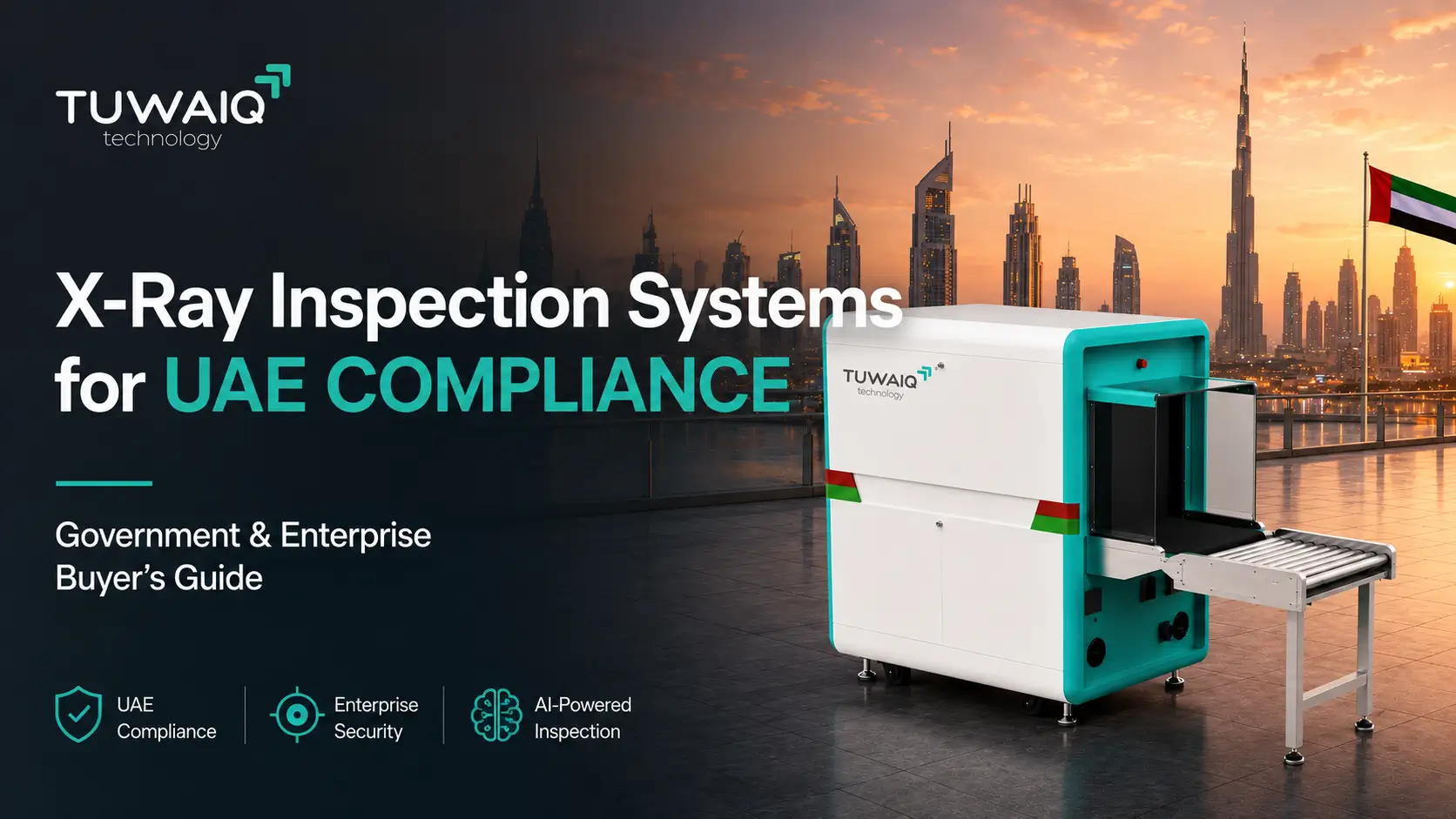
X-Ray Inspection Systems for UAE Compliance: What Government & Enterprise Buyers Need to Know
Buying an X-ray inspection system in the UAE is not simply a matter of comparing tunnel size, image quality and price. Government departments, airports, logistics facilities, hotels, commercial developments and enterprise security teams must also consider radiation safety, licensing, operator procedures, installation and long-term technical support.
For procurement teams, the right solution is therefore not necessarily the scanner with the longest specification sheet. It is the system that matches the intended screening application and can be deployed and operated within the relevant UAE regulatory framework.
This guide focuses specifically on the compliance considerations UAE buyers should understand before purchasing an X-ray inspection system.
What Is an X-Ray Inspection System?
An X-ray inspection system allows security teams to inspect bags, parcels, luggage and cargo without physically opening each item. The scanner generates an image that trained operators use to assess the contents and identify potentially prohibited or suspicious objects.
For a complete explanation of X-ray scanner technology, imaging features and selection criteria, see our Complete Guide to X-Ray Baggage Scanners.
UAE Compliance Starts With Radiation Regulation
One of the most important differences between purchasing ordinary security equipment and purchasing an X-ray inspection system is that an X-ray scanner contains a radiation generator.
In the UAE, the Federal Authority for Nuclear Regulation (FANR) regulates activities involving radiation generators. FANR provides licensing and regulatory services and has issued dedicated guidance for the safe operation of X-ray security scanners.
For buyers, this means compliance planning should begin before equipment is ordered or shipped, not after the scanner arrives at site.
1. Licensing and Authorization
The organization operating the equipment should confirm which FANR authorization or licensing requirements apply to its activities and intended equipment.
2. Radiation Protection and Safety Programme
Organizations may need to maintain appropriate radiation-protection arrangements covering equipment locations, responsibilities, operational controls and relevant safety procedures.
3. Qualified Operators
X-ray equipment should be operated by personnel who understand the system, screening process and applicable radiation-safety requirements.
4. Training
Personnel working with X-ray security equipment should receive appropriate equipment and radiation-safety training, with records maintained where required.
5. Written Operating Procedures
Operating, safety and emergency procedures should be clearly established and available to the personnel responsible for the equipment.
6. Import and Shipment Planning
Regulatory and import requirements should be checked before shipment. FANR guidance addresses advance permission relating to the import and export of X-ray security scanners, making early compliance planning an important part of procurement.
What About Dubai SIRA Requirements?
Dubai projects may also involve requirements from the Security Industry Regulatory Agency (SIRA) depending on the equipment category, approved security-system scope and project requirements.
SIRA operates certification processes for security equipment intended for use within regulated security systems in Dubai.
The applicability should therefore be confirmed for the specific project and equipment, rather than assuming the same requirement applies to every X-ray scanner or every emirate.
Government, aviation, customs and critical-infrastructure projects may also include additional authority- or tender-specific requirements.
The Key Procurement Point
Do not treat “CE certified” or “internationally certified” as the complete answer to UAE compliance.
International certifications can be valuable technical evidence, but UAE buyers must also consider the local licensing, import, installation and operational requirements applicable to the project.
Technical Specifications UAE Buyers Should Compare
Once the regulatory route is understood, the equipment itself can be evaluated.
Important technical criteria include:
- جودة ووضوح صور الأشعة السينية
- دقة تمييز الأسلاك
- قدرة اختراق الفولاذ
- تصنيف المواد
- Conveyor performance
- Operator interface
- موثوقية عالية
- Duty cycle
- Environmental conditions
- Available software and security options
حجم النفق
Tunnel size should match the actual items being screened rather than being selected purely on the basis of “bigger is better.”
Depending on the application, UAE projects can consider models such as:
- إنسْبِكتا™ 6040: compact and standard checkpoint applications.
- إنسْبِكتا™ 6550 : general baggage and visitor screening.
- إنسبكتا™ 6550D : dual-view checkpoint screening.
- إنسْبِكتا™ 7555 / 7555D : larger baggage and higher-capacity checkpoint applications.
- إنسبكتا™ 1010D : large baggage, parcels and cargo.
- إنسبكتا™ 151181D : oversized freight and high-volume cargo inspection.
Single View vs Dual View
The correct choice depends on the security level, traffic, baggage type and inspection requirement. For a full comparison, see our Single View vs Dual View X-Ray Baggage Scanners guide.
For UAE projects requiring dual-angle inspection, the إنسبكتا™ 6550D is one example of a dual-view checkpoint configuration.
AI-Assisted Threat Recognition
AI should support trained security operators rather than replace human judgment, procedures or regulatory responsibilities; for the full technology overview, see Raytina 2.0 AI Security Inspection.
Match the Scanner to the UAE Facility
Government Buildings and Embassies
Government and controlled facilities typically need reliable checkpoint screening, clear operator controls and configurations matched to the project’s security level.
Hotels and Commercial Buildings
Hotels and commercial properties normally need effective screening with minimal impact on guest flow, entrance design and visitor experience.
Airports and High-Security Facilities
Airport and higher-risk applications may require increased throughput, advanced inspection configurations and project-specific authority compliance.
Logistics, Ports and Cargo Facilities
Logistics and cargo sites require equipment selected around package dimensions, freight type, load capacity and high-volume operational requirements.
For the detailed application breakdown, see our X-Ray Baggage Scanners for UAE Airports, Hotels & Malls guide.
Do Not Ignore After-Sales Support
Compliance and technical suitability are only part of the procurement decision.
An X-ray inspection system may operate for many years, so buyers should also confirm:
- Installation capability
- Commissioning support
- تدريب المشغلين
- Preventive maintenance
- Corrective maintenance response
- Spare-parts availability
- Software support
- Technical documentation
- Warranty coverage
- Future upgrade options
A scanner that meets the technical requirement on delivery can still become an operational risk if qualified support or spare parts are unavailable later.
This is especially important for government and enterprise environments where equipment downtime can directly affect access control and security operations.
Why Tuwaiq Technology?
Tuwaiq Technology provides a range of INSPECTA™ X-ray security inspection systems for government, commercial, checkpoint and cargo applications across the UAE and wider GCC.
Our approach combines suitable equipment selection with project planning, training, technical support and long-term lifecycle considerations.
For UAE projects, our team can review the intended application, facility type, baggage profile, operational requirements and equipment configuration before recommending an appropriate INSPECTA™ solution.
Planning an X-Ray Inspection System for a UAE Project?
تواصل مع طويق للتقنية with your facility type, project location, security requirements and expected screening application.
Our team can help identify the appropriate INSPECTA™ configuration and the technical documentation required for the project.
الأسئلة الشائعة
اسألنا عن
أي شيء
Does an X-ray inspection system require approval in the UAE?
X-ray security scanners contain radiation generators, so the relevant FANR licensing, safety and import requirements should be confirmed before deployment. Additional project- or authority-specific requirements may also apply.
What is FANR's role in X-ray security scanners?
FANR regulates activities involving radiation generators in the UAE and provides requirements and guidance relating to radiation safety and authorized use.
Is CE certification enough for an X-ray scanner in the UAE?
No. CE or other international certifications may support technical evaluation, but they do not replace applicable UAE licensing, import or project-specific regulatory requirements.
Does SIRA apply to every X-ray scanner in the UAE?
Not necessarily. SIRA is relevant to regulated security systems in Dubai, and applicability depends on the specific equipment and project scope.
Why should compliance be checked before shipment?
Because licensing, documentation and import requirements can affect whether the equipment can legally and practically be brought into the UAE and operated at the intended site.
Does Tuwaiq Technology support UAE X-ray inspection projects?
Yes. Tuwaiq Technology supports project evaluation, equipment selection, installation, training and technical-support requirements for INSPECTA™ screening systems across the UAE and GCC.
إشارة مرجعية: X-Ray Baggage Scanner Supplier UAE: Buyer Guide
إشارة مرجعية: X-Ray Baggage Scanner Price UAE: Buyer’s Guide