

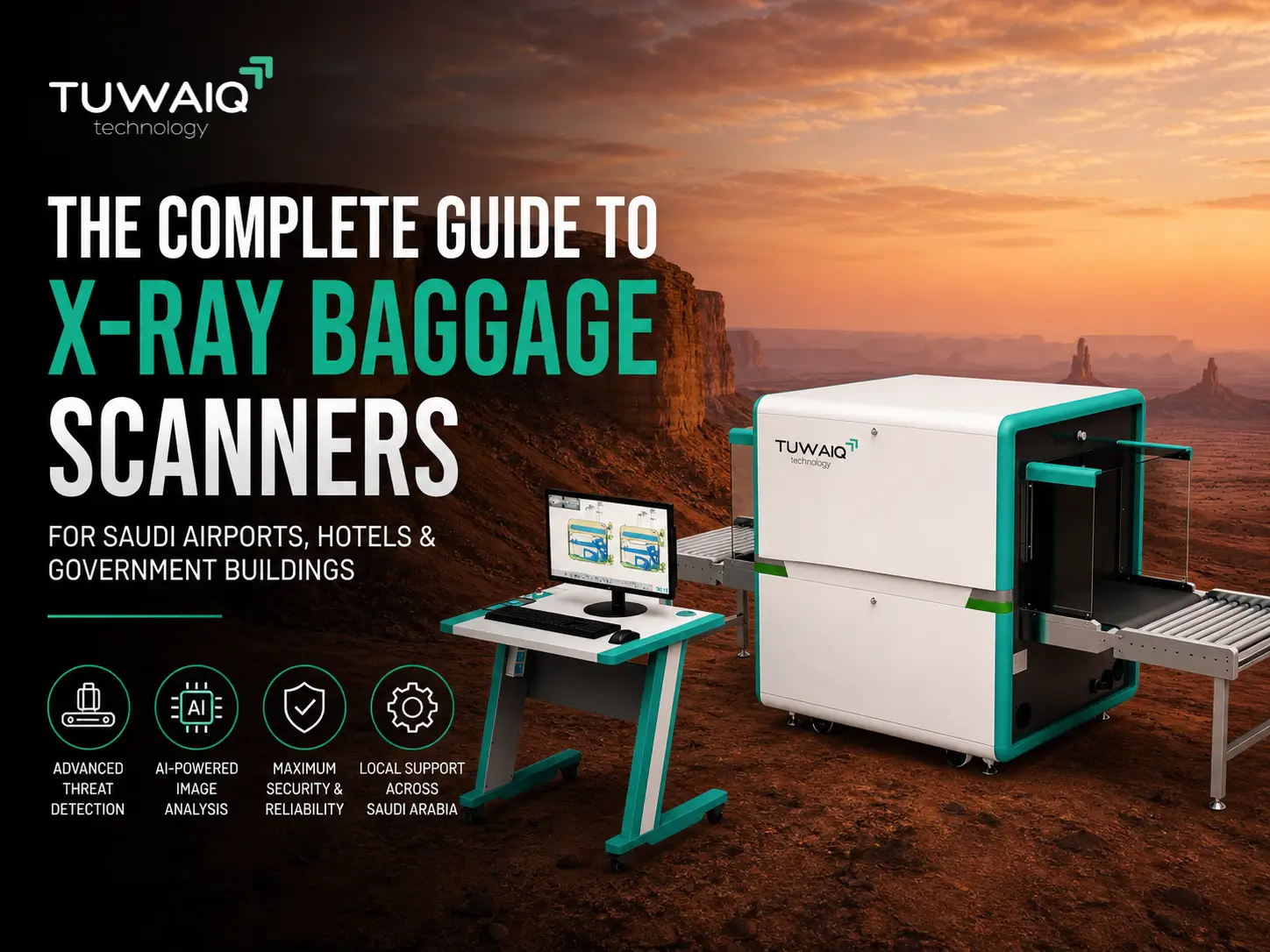
Focus: Everything you need to know about X-ray baggage scanners: how they work, what to look for, and why Tuwaiq Technology is Saudi Arabia’s trusted security partner.
X-ray baggage scanners are the backbone of modern physical security. Whether at a busy international airport, a five-star hotel lobby in Riyadh, or a government ministry entrance, these machines give security personnel a real-time, non-invasive view of what is inside every bag and parcel.
At Tuwaiq Technology, we supply, install, and maintain industry-leading X-ray baggage scanning systems across Saudi Arabia, Qatar, and the UAE. This guide explains how an x ray baggage scanner works, what features matter most, and how to choose the right solution for your facility.
How X-Ray Baggage Scanners Work
When a bag passes through the scanner tunnel on a conveyor belt, a low-dose X-ray beam penetrates the contents. Different materials absorb X-rays at different rates.
The machine’s sensors detect this variation and generate a colour-coded image:
- Orange tones typically indicate organic materials (food, plastics, drugs, and some explosives)
- Blue tones indicate inorganic or metallic materials (guns, knives, tools)
- Green tones indicate materials of mixed or intermediate density
Trained operators interpret these images in real time, flagging suspicious items for further investigation. This is how a security x ray baggage scanner catches threats without ever opening a bag.
Key Features to Look for in an X-Ray Baggage Scanner
Not every xray baggage scanner is built the same way. Here is what separates a reliable system from an average one.
Image Resolution: Higher resolution means clearer, more detailed images, which is critical for spotting concealed threats in cluttered bags. Look for systems offering at least 1024 x 1024 pixel resolution.
Dual-Energy Imaging: This technology uses two different X-ray energy levels to better distinguish between organic and inorganic materials, which significantly improves threat detection accuracy.
Tunnel Size: Standard checkpoint scanners typically offer tunnel dimensions of 600mm (W) x 400mm (H). For hold baggage, oversized luggage, or cargo, larger tunnel configurations are required.
Throughput Speed: For high-traffic environments like airports or mass events, conveyor speed and processing time matter a lot. Industry data from manufacturers such as Smiths Detection shows that modern hold-baggage and checkpoint systems can process up to 1,800 bags per hour, though real-world throughput depends on false alarm rates and how the checkpoint is staffed.
AI-Assisted Threat Detection: Modern scanners increasingly use artificial intelligence and machine learning to automatically flag anomalies, reducing operator fatigue and human error. You can read more about how Tuwaiq applies this on our technology page.
Certifications: For aviation applications, make sure the system carries relevant certifications such as TSA approval, ECAC EDS standards, or an equivalent regional aviation authority accreditation.
When you compare the best x ray baggage scanner options for your facility, weigh all six of these together rather than picking on price or resolution alone.
Where X-Ray Baggage Scanners Are Deployed in Saudi Arabia
- King Khalid International Airport (Riyadh) and other Saudi airports for passenger checkpoint and hold baggage screening, an area where an x ray baggage scanner for airports needs to balance speed with accuracy
- Five-star hotels and resorts, particularly properties hosting international dignitaries or events
- Government ministries and royal court facilities requiring the highest levels of discretion and reliability
- Courts, prisons, and detention centres for secure perimeter management
- Corporate headquarters and data centres protecting sensitive assets and personnel
- Event venues, from Formula E races to the Saudi Cup horse racing event
Maintenance and Local Support: Why It Matters
Purchasing a scanner is only the beginning. Long-term operational performance depends on preventative maintenance, rapid spare parts availability, and qualified local technical support.
Tuwaiq Technology’s team of certified engineers provides ongoing maintenance contracts, operator training, and 24/7 technical assistance across the Kingdom, ensuring maximum system uptime when it matters most.
Ready to upgrade your screening capability? Contact Tuwaiq Technology for a free consultation and site assessment.
FAQ
ask us
anything
How do X-ray baggage scanners work in airports, hotels, and government buildings?
X-ray baggage scanners work by passing a low-dose X-ray beam through bags and parcels on a conveyor belt. Different materials absorb X-rays at different rates, generating a colour-coded image that trained security operators interpret in real time to identify threats without needing to open the bag.
What should I look for when choosing an X-ray baggage scanner for a facility in Saudi Arabia?
Key factors include image resolution, tunnel size, conveyor throughput speed, dual-energy imaging capability, and AI-assisted threat detection. For aviation environments, make sure the system carries the relevant certifications such as ECAC EDS standards or an equivalent regional aviation authority accreditation.
Which facilities in Saudi Arabia commonly use X-ray baggage scanners?
X-ray baggage scanners are widely used across Saudi airports, five-star hotels, government ministries, courts, prisons, corporate headquarters, data centres, and large event venues, anywhere reliable and non-invasive baggage inspection is required at a security checkpoint.
What is the difference between single-view and dual-view X-ray baggage scanners?
A single-view scanner captures one image angle of the scanned item, while a dual-view scanner uses two X-ray sources at different angles to capture both horizontal and vertical images at the same time. This gives a more complete, blind-spot-free view of the bag contents for better threat detection. See our full single-view vs dual-view comparison for a deeper breakdown.
Does Tuwaiq Technology provide installation, training, and after-sales support for X-ray baggage scanners in Saudi Arabia?
Yes. Tuwaiq Technology provides full support including installation, operator training, preventative maintenance contracts, and technical assistance across Saudi Arabia, ensuring maximum system uptime and reliable long-term performance for your security screening operations.
Pingback: X-Ray Inspection System UAE: FANR & SIRA Compliance Guide