

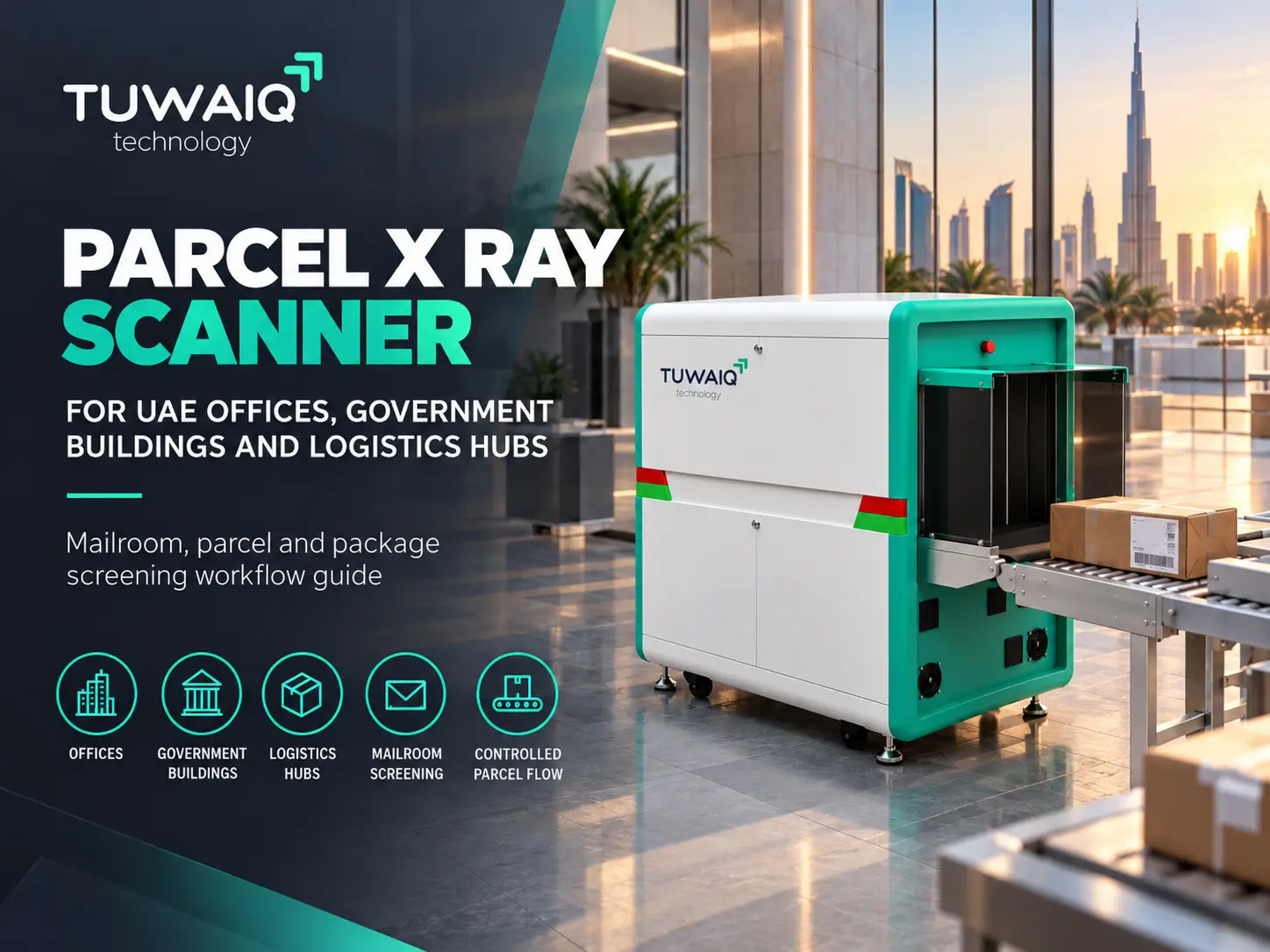
Parcel X Ray Scanner for UAE Offices, Government Buildings and Logistics Hubs
A parcel X ray scanner helps offices and logistics hubs control what enters a building, because parcels arrive every day.
Courier envelopes, online orders, documents, cartons, supplier deliveries, IT equipment and internal packages may all pass through reception desks, mailrooms and loading areas before reaching employees or departments.
For security-sensitive facilities, allowing these items to move directly into the building without inspection can create an avoidable gap in the overall security process.
A parcel X ray scanner allows security teams to inspect packages without opening every item manually.
For UAE offices, government buildings, corporate facilities and logistics operations, the scanner can become part of a structured parcel-handling process that controls how deliveries enter, move through and leave the screening area.
This guide explains where parcel screening is useful, how the workflow should operate and what buyers should consider when selecting a system.
What Is a Parcel X Ray Scanner?
A parcel X-ray scanner is a security inspection system used to view the contents of packages, boxes, envelopes, bags and other items without physically opening them.
Packages move through the scanner on a conveyor while the operator reviews the generated X-ray image.
Parcel scanners are commonly used where incoming items need to be checked before they move deeper into a facility.
Typical locations include:
- Corporate mailrooms
- Government buildings
- Office towers
- Embassies
- Hotels
- Courier facilities
- Logistics hubs
- Warehouses
- Distribution centres
- Controlled reception areas
The required scanner should be selected around the actual packages handled by the facility rather than simply choosing the smallest or largest available system.
Explore the complete Tuwaiq X-ray baggage scanner range.
Why Parcel Screening Matters
Many buildings have strong security at their main entrance.
Visitors may pass through access control or personnel screening, while handbags and personal belongings may be checked separately.
Deliveries, however, may enter through a completely different route.
A courier may leave a package at reception.
A supplier may deliver cartons to a loading entrance.
An internal mail team may collect dozens of packages before distributing them throughout the building.
If those items bypass the security process, the facility has a separate entry path that needs to be considered.
A parcel-screening system helps create a defined control point before packages are distributed internally.
Parcel Screening for UAE Office Buildings
Corporate offices can receive a wide variety of deliveries throughout the day.
These may include:
- Documents
- Courier envelopes
- Employee deliveries
- Online purchases
- Replacement equipment
- Samples
- IT hardware
- Small cartons
- Supplier packages
The mailroom or reception team should ideally have a clear procedure for receiving these items.
A practical process may be:
Receive → Register → Screen → Clear or Escalate → Sort → Deliver
This is more controlled than allowing couriers or packages to move directly to individual departments.
For smaller corporate mailrooms and office environments, the Tuwaiq Small Parcel Baggage Scanner range provides compact systems designed for parcels, documents and hand-carry items.
Parcel Screening for Government Buildings
Government facilities may receive documents, official correspondence, contractor deliveries, supplies and packages for multiple departments.
A centralized parcel-screening point can help security personnel control these deliveries before they enter secure areas.
The workflow can include:
- Courier or package arrives.
- Delivery information is checked.
- Package is directed to the screening area.
- Parcel passes through the X-ray scanner.
- Operator reviews the image.
- Cleared package enters the internal distribution process.
- Any item requiring additional inspection is isolated according to the facility’s security procedure.
This creates a separation between delivery receipt and internal access.
The package does not automatically gain access to the building simply because it has been accepted by reception.
For government offices, mailrooms and similar checkpoints, the INSPECTA™ 6040 is one of the compact screening options available within the Tuwaiq range.
Parcel Screening for Logistics and Courier Hubs
Logistics environments have a different challenge.
Instead of a few deliveries arriving during the day, the facility may process a continuous flow of cartons, parcels and consignments.
The scanner therefore needs to fit into the operational process without creating an unnecessary bottleneck.
Important questions include:
- What is the average parcel size?
- What is the largest package expected?
- How many parcels are processed during peak periods?
- Will packages arrive individually or in batches?
- How will suspicious items be removed from the main flow?
- Is image archiving required?
- Will the scanner operate for extended shifts?
- Does the site require multiple screening lanes?
A parcel scanner for a corporate mailroom and a system for a high-volume logistics hub may therefore belong to very different equipment classes.
For larger parcels, cartons and higher-capacity screening, buyers can also review the INSPECTA™ 1010 large-tunnel X-ray scanner.
Build the Workflow Before Choosing the Scanner
A common procurement mistake is selecting the scanner first and designing the parcel process later.
The better approach is to map the workflow.
Start with five questions.
1. Where Do Parcels Enter the Facility?
Identify every delivery entrance.
This could include:
- Main reception
- Staff entrance
- Loading bay
- Service entrance
- Mailroom
- Warehouse
- Courier collection area
If deliveries enter through several locations, decide whether screening will be centralized or whether more than one checkpoint is required.
2. Who Receives the Parcel?
Responsibility should be clear.
Depending on the site, packages may be received by:
- Security
- Reception staff
- Mailroom personnel
- Logistics staff
- Facility management
- Warehouse personnel
The person receiving the package does not necessarily need to be the scanner operator, but the handover process should be defined.
3. Where Will Screening Take Place?
The parcel scanner should be placed where items can be moved through the system without interfering with normal visitor traffic.
A practical mailroom layout may include:
Incoming area → registration → X-ray scanner → cleared-item area → internal distribution
Packages requiring further attention should move to a separate controlled area rather than remaining in the cleared-items flow.
4. What Happens After Screening?
Screening is only useful if the next action is defined.
A parcel may be:
- Cleared
- Held for additional inspection
- Returned to the courier
- Escalated to security management
- Managed according to the facility’s emergency procedure
Operators should know which action is required before the system goes live.
5. How Will Cleared Parcels Be Distributed?
Once a parcel has been screened, it should enter a controlled internal-delivery process.
This may involve:
- Department collection
- Mailroom delivery
- Internal tracking
- Courier handover
- Secure storage before collection
Keeping cleared and unscreened packages physically separated can help prevent confusion.
Choosing the Right Parcel Scanner Size
Tunnel size matters, but it should not dominate the whole purchasing decision.
The basic rule is straightforward:
Choose a scanner that comfortably accommodates the packages your facility actually receives.
A small office mailroom primarily handling envelopes, handbags and compact packages may require a different system from a warehouse receiving large cartons.
Before requesting a quotation, review:
- Typical package dimensions
- Largest expected package
- Package weight
- Daily volume
- Peak-hour volume
- Available installation space
Tuwaiq’s X-ray baggage scanner range includes compact parcel systems, standard checkpoint scanners and larger systems for higher-capacity applications.
Small Offices and Corporate Mailrooms
For smaller mailrooms, the priority is often a compact footprint combined with clear daily screening.
The scanner may need to fit into:
- Reception back offices
- Mailrooms
- Security rooms
- Controlled entrance areas
- Limited floor space
The Tuwaiq Small Parcel Baggage Scanner range includes compact systems intended for parcels, hand-carry items, offices and similar screening checkpoints.
For particularly compact requirements, buyers can review the INSPECTA™ 5335.
Where a larger compact tunnel is required, the INSPECTA™ 6040 provides another option.
Oversizing the system can consume unnecessary space and budget without improving the actual mailroom workflow.
Government and Enterprise Mailrooms
Larger government and enterprise facilities may handle a broader range of items.
The scanner selection may need to consider:
- Higher delivery volume
- Larger cartons
- Multiple departments
- Extended operating hours
- Centralized distribution
- Image archiving
- Operator access control
- Network or reporting requirements
A checkpoint-class scanner may be more appropriate where package dimensions or daily volume exceed the requirements of a compact mailroom system.
For these applications, buyers can review the Tuwaiq checkpoint baggage scanner range or the INSPECTA™ 6550.
The correct system should follow the parcel profile and security requirement.
Logistics Hubs and Distribution Centres
At logistics hubs, throughput becomes increasingly important.
A scanner should not be evaluated only by its physical tunnel opening.
Buyers should also consider:
- Conveyor operation
- Duty cycle
- Package handling
- Operator workstation
- Queue accumulation
- Screening speed
- Large and dense items
- Space before and after the conveyor
- Maintenance access
Large parcels or freight may require a larger-tunnel scanner rather than equipment intended for office mailrooms.
The INSPECTA™ 1010 is designed for larger parcels, boxes, freight and bulky packages where greater tunnel capacity is required.
Where Should a Parcel X Ray Scanner Be Installed?
The scanner should be part of a controlled parcel-handling area.
The location should provide enough space for:
- Incoming parcels
- Operator workstation
- Scanner
- Entry and exit conveyor areas
- Cleared-item staging
- Items requiring further inspection
- Operator access
- Maintenance access
Avoid positioning the scanner where screened and unscreened packages can easily become mixed.
For mailrooms, simple physical separation between incoming, screened and held items can make the workflow significantly clearer.
Operator Position and Visibility
The operator should have an unobstructed view of:
- Incoming packages
- Conveyor movement
- Scanner display
- Cleared-item area
- Any secondary-inspection location
The workstation should also be positioned so that the operator is not repeatedly interrupted by unrelated reception or administrative activities.
At busy facilities, parcel screening should be treated as a defined security function rather than an additional task assigned to someone who cannot monitor the scanner continuously.
What Should Operators Look for?
The role of an X-ray operator is to assess the image according to the facility’s training and security procedures.
Operators should receive appropriate training in:
- System operation
- Image interpretation
- Image-enhancement controls
- Material differentiation
- Recognizing items requiring further examination
- Handling unclear images
- Escalation procedures
- Routine equipment checks
The security procedure should define what happens when the operator cannot confidently clear an item.
The scanner supports the decision-making process; it does not replace the site’s security policy.
What Happens If a Parcel Cannot Be Cleared?
A parcel that requires further attention should not simply be opened next to the main screening queue.
The organization should establish a controlled procedure before operations begin.
Depending on the facility’s approved security process, this could include:
- Holding the package
- Moving it to a designated inspection area
- Escalating to a supervisor
- Contacting the recipient
- Returning the package
- Following emergency or specialist-response procedures where necessary
The exact procedure should be defined by the organization’s security management and applicable authority requirements.
The important operational point is that the main parcel-screening process should have a clear exception path.
Parcel Screening and Visitor Screening Are Different
A parcel X-ray scanner should not be confused with personnel screening.
The scanner is used for packages and belongings.
Where people also require screening, the security checkpoint may include:
- X-ray baggage scanner for bags or parcels
- Walk-through metal detector for primary personnel screening
- Handheld metal detector for secondary personnel inspection
For mailrooms located away from the public entrance, personnel screening may already take place elsewhere in the building.
The parcel scanner therefore closes a different part of the security workflow.
How Much Does a Parcel X Ray Scanner Cost in the UAE?
Price depends on the system class and project requirement.
Factors can include:
- Tunnel size
- Image performance
- Scanner configuration
- Accessories
- Installation
- Operator workstation
- Warranty
- Maintenance
- Project requirements
For a full cost breakdown, read our X-ray baggage scanner price guide for the UAE.
For a parcel-screening project, the most useful quotation starts with your actual package size, daily volume and site requirements.
What About Single View vs Dual View?
Single-view and dual-view systems have different imaging configurations and may suit different security requirements.
If view configuration is part of your procurement decision, read Single View vs Dual View X-Ray Baggage Scanners: Which One Do You Need?.
For most buyers, view selection should follow the risk level and screening requirement rather than being chosen simply because one configuration has a higher specification.
What About UAE Compliance?
X-ray security scanners use radiation-generating equipment, so UAE deployment needs appropriate regulatory and project planning.
The exact requirements depend on the organization, equipment and project.
Tuwaiq covers this separately in the X-Ray Inspection System UAE: FANR & SIRA Compliance Guide.
Compliance should be reviewed before ordering or shipping the equipment rather than after the scanner reaches the site.
For models, supply and support on UAE projects, visit our X-ray baggage scanner UAE page.
Parcel Scanner Selection Checklist
Before requesting a quotation, prepare the following information:
| Requirement | Information to Confirm |
|---|---|
| Facility type | Office, government, logistics, warehouse, etc. |
| UAE location | Emirate and project location |
| Package type | Envelopes, parcels, cartons, mixed items |
| Largest package | Approximate dimensions |
| Package weight | Typical and maximum |
| Daily volume | Average parcels per day |
| Peak volume | Busy-hour requirement |
| Operating hours | Normal or extended shifts |
| Installation space | Available screening area |
| Screening workflow | Incoming, cleared and held-item areas |
| Operator requirement | Number of operators/shifts |
| Support | Installation, training and maintenance |
| Project requirements | Regulatory, authority or tender requirements |
Providing this information makes it much easier to select a scanner that matches the actual operation.
Tuwaiq Parcel Screening Solutions
Tuwaiq Technology provides X-ray systems covering compact mailroom screening through larger checkpoint and logistics applications.
For smaller packages and controlled entrances, explore the Small Parcel Baggage Scanner range.
For larger baggage and higher-volume checkpoints, explore the Checkpoint Baggage Scanner range.
For logistics operations handling larger parcels, boxes or freight, the INSPECTA™ 1010 provides a larger-tunnel option.
The right system should therefore be selected by parcel profile + throughput + security requirement, not by model number alone.
Parcel X Ray Scanner for UAE Facilities: The Key Takeaway
A parcel X ray scanner is most effective when it forms part of a complete delivery-control process.
The scanner itself is only one stage.
A strong workflow should answer:
Where does the package arrive?
Who receives it?
Where is it screened?
What happens if it is cleared?
What happens if it requires further inspection?
How does it reach the final recipient?
For UAE offices and government buildings, this creates a controlled mailroom process.
For courier and logistics hubs, the same principle applies at a much larger scale: packages should move through defined screening, clearance and exception paths without disrupting the wider operation.
Planning a Parcel Screening Project in the UAE?
Explore the complete Tuwaiq X-ray baggage scanner range, review the Small Parcel Baggage Scanner range, or contact Tuwaiq Technology to discuss your UAE office, government or logistics screening project.
FAQ
ask us
anything
What is a parcel X ray scanner used for?
A parcel X-ray scanner is used to inspect packages, boxes, envelopes and other items without physically opening them. It can be used in mailrooms, offices, government buildings, logistics centres and controlled delivery areas.
Which X-ray scanner is suitable for a mailroom?
The appropriate scanner depends on the size and weight of packages, daily volume, available floor space and security requirement. Buyers can start with the Tuwaiq Small Parcel Baggage Scanner range.
Can parcel X ray scanners be used in government buildings?
Yes. X-ray parcel scanners can support controlled inspection of documents, packages, contractor deliveries and other incoming items before internal distribution.
Are parcel scanners suitable for logistics hubs?
Yes, but logistics facilities may require larger or higher-capacity equipment depending on parcel dimensions, throughput, operating hours and package density. Review the INSPECTA™ 1010 for larger parcel and freight applications.
Should screened and unscreened parcels be kept separate?
Yes. Keeping incoming, cleared and held items in defined areas helps maintain a controlled mailroom or parcel-screening workflow.
Does Tuwaiq provide parcel X-ray scanners for UAE projects?
Tuwaiq Technology provides compact parcel scanners, checkpoint systems and larger X-ray screening systems for projects across the UAE and GCC. Contact Tuwaiq Technology to discuss the facility, package size, throughput and project requirement.